
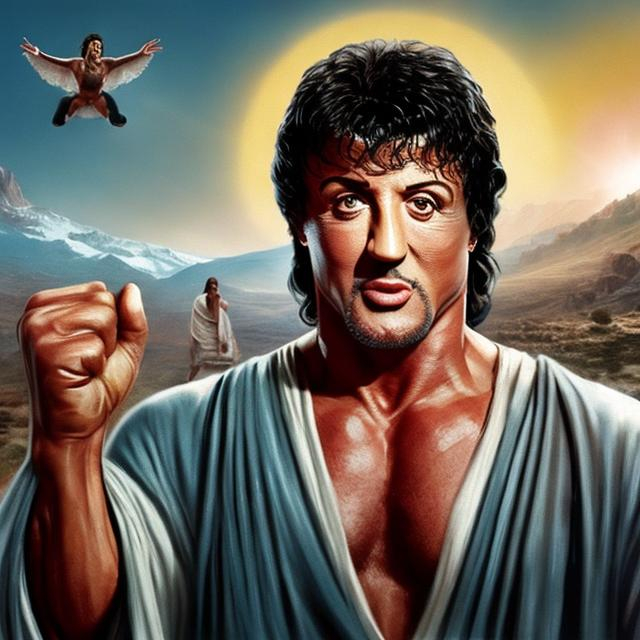
When “Rocky” premiered in 1976, it was more than a mere cinematic experience—it was an existential odyssey into the heart of human struggle and the search for meaning in a seemingly indifferent universe. Sylvester Stallone’s character, Rocky Balboa, emerges as the Sisyphean figure—his training and fights are his boulder, his ring a personal Mount Olympus. His relentless toil and repeated blows are the absurd trials through which he seeks his essence. Every bruise and setback, rather than diminishing him, only serve to carve his existence deeper into the fabric of the world. Camus would argue that it is this perpetual confrontation with the limits of one’s ambition that one finds the profound joy of life.
Albert Camus once wrote, “One must imagine Sisyphus happy.” In the vein of Camus’s philosophy, Rocky’s relentless pursuit of boxing greatness, despite the odds, embodies the absurd hero who finds joy in the struggle itself. His bouts are less about the victory and more about the act of rebelling against the limitations imposed upon him by his circumstances. Rocky’s journey in the ring becomes a microcosm for the human experience, each round a representation of life’s cyclical and often repetitive challenges. Within this cycle, Rocky finds his happiness, not in the fleeting ecstasy of triumph, but in the grueling consistency of the fight. It’s in the spaces between the rounds, as he sits in his corner of the ring, that we see his quiet resolve reflecting Camus’ philosophy of embracing life’s absurdity.
In Rocky’s world, as in the existential universe, God is conspicuously absent, and man is left alone to forge his destiny. Jean-Paul Sartre’s assertion that “man is condemned to be free” resonates through Rocky’s journey. He is free to make choices, from the moral quandaries he faces when collecting debts to the love he chooses to pursue with Adrian. His love story with Adrian is itself an act of creating meaning, an assertion of will in the face of emotional barrenness. Each punch he lands against his opponents symbolizes a small victory against the vast emptiness of existence. In the intimacy of Adrian’s shy gaze and in the brutality of the boxing ring, Rocky confronts his freedom and its attendant responsibilities.
The gritty streets of Philadelphia provide a backdrop that reflects Sartre’s notion of “existence precedes essence.” Rocky, the man, is not defined by any predetermined essence or destiny. Instead, it is through his actions, his training, his fighting, and his loving that he defines himself. The raw environment of the city, with its cold, hard surfaces, forces Rocky to carve out a place for himself. In the smoke-filled arenas and the lonely streets at dawn, Rocky’s existence is continuously asserted and reasserted with each step, each jab, each moment of tenderness. The film, in this existential light, portrays each person as a sculptor of their own destiny, with Rocky leading the charge with his own bruised hands.
Moreover, Rocky’s relationship with Adrian is a narrative dance around Kierkegaard’s idea of the aesthetic and ethical stages of life. Initially, Rocky appears to be in the aesthetic stage, living a life of immediate gratification and superficial pursuits. However, as he forges his bond with Adrian, he transitions into the ethical stage, taking on responsibilities and striving for a greater sense of purpose. Adrian becomes the mirror through which Rocky views his potential for transformation. Kierkegaard would see their burgeoning relationship as the catalyst that pushes Rocky towards the realization of an authentic self. This progression from aesthetic to ethical is painted in the quiet, unspoken moments they share, as well as the loud, chaotic bouts in the ring, mirroring life’s own dichotomy of silence and noise.
Kierkegaard tells us that “to dare is to lose one’s footing momentarily. Not to dare is to lose oneself.” Rocky dares greatly, and in doing so, he risks losing himself in the fight, only to discover his true self in the process. The blows he endures are as much existential as they are physical; they are the universe’s indifference made manifest. Yet, he endures, embracing the suffering as a crucible for self-realization. In the monotonous repetition of punches, the ritualistic dance around the ring, Rocky faces the terror of non-being and responds with a resounding affirmation of life. He stands, round after round, as a testament to Kierkegaard’s leap of faith—into the ring, into love, into life. Each drop of blood and sweat on the mat is a testament to his existential courage, his defiance of despair.
In the climactic fight, Apollo Creed represents more than an opponent—he is the embodiment of the world’s indifference, the chaos against which Rocky defines himself. Their fight is a dance of existence, a physical dialogue where each punch carries the weight of Rocky’s personal philosophy. This is a man fighting not for the world’s acclaim, but for the assertion of his existence on his own terms. Apollo’s prowess and confidence stand as the antithesis to Rocky’s underdog tenacity, underscoring the stark contrasts between their worlds. As the fight rages on, Rocky’s battered body becomes a canvas displaying the marks of his existential journey. Through his opponent, Rocky engages in a conversation about worth, meaning, and identity—themes that echo loudly in the empty halls of existential philosophy.
In “Rocky,” the audience finds a mirror to the existential struggle we all face. The fight is a metaphor for life—fraught with pain, seemingly unfair, and ultimately without inherent meaning. It is a narrative that compels us to reflect on Sartre’s words, “Life has no meaning the moment you lose the illusion of being eternal.” The film’s final moments, with Rocky and Apollo exhausted and clinging to one another, reflect an authentic brotherhood that transcends the fight itself. They share a bond that only those who have faced the absurd together can understand. And as the crowd fades into a blur, and the verdict becomes irrelevant, Rocky’s triumph is solidified not in a title, but in the undeniable proof of his existence.
“Rocky” thus stands as a testament to the resilience of the human spirit in the face of the absurd, and a reminder that, as Kierkegaard posits, the most important thing is to find a purpose that is worth living for. Rocky finds his purpose in the fight, and in doing so, challenges us to find ours. The resonance of Rocky’s journey lies not in the triumphs he accumulates, but in the shared human condition of seeking purpose amidst the chaos. The final bell does not signal the end, but a continuation—the existential fight goes on, within the ring of our own lives.
 Bat Shit Movie Reviews
Leave a comment