
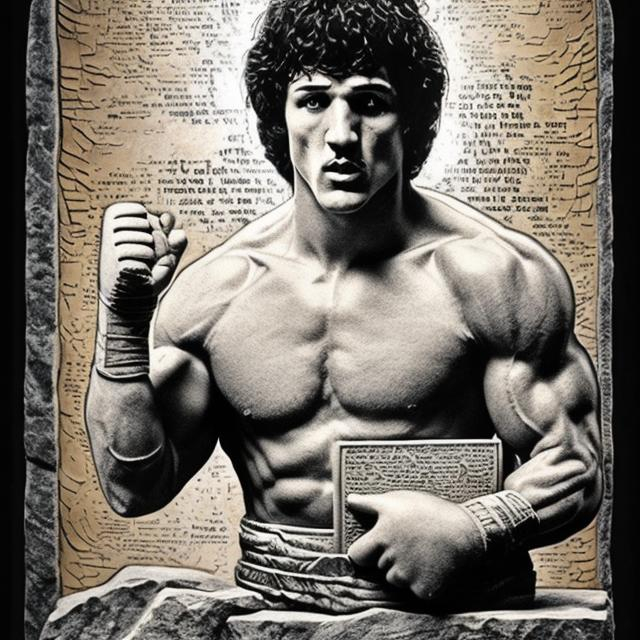
“We are our choices.”
– Jean-Paul Sartre
“Rocky II” intensifies the existential narrative of its predecessor, weaving a deeper examination of Rocky Balboa’s personal odyssey through life’s inherent meaninglessness. In the spirit of Albert Camus, Rocky’s journey underscores the absurdity of his situation following his brush with victory. Camus’s thought that “The only way to deal with an unfree world is to become so absolutely free that your very existence is an act of rebellion,” is paralleled in Rocky’s response to his new reality. At the onset, Rocky tries to find contentment in domestic life and commercial endorsements, yet these endeavors feel hollow. It’s in his return to the ring that we see Rocky’s act of rebellion against an existence that feels foreign to him. His life outside the ring seems plagued by a quiet desperation, exemplified in the scene where he stands in the empty arena, confessing to Adrian, “I never asked you to stop being a woman, you know. Please, don’t ask me to stop being a man.” Rocky acknowledges that his true self cannot be severed from the fighter within, which reflects Camus’s sentiment that one must carve a path of authenticity even in the face of life’s absurdities.
Rocky’s realization of his need to fight again, to define himself by his own terms, mirrors Jean-Paul Sartre’s existential creed: “We are our choices.” Throughout “Rocky II,” Rocky is confronted by the consequences of his previous bout—both physically and emotionally—and yet, he chooses to return to what he feels he must do. This is not a mere hobby or career but a calling that defines his essence. In the hospital, facing the gravity of his situation, Rocky asks Apollo, “You think we coulda done better, huh?” This acknowledgment of lingering potential and unfinished business with Apollo sets the stage for Rocky’s existential choice—the choice to risk everything to be true to himself, underscoring Sartre’s philosophy that we are the sum of our actions.
The echoes of Søren Kierkegaard’s existential anxiety reverberate through Rocky’s tumultuous path to the rematch. Faced with the fear of going blind and the tangible dread of losing his family’s financial stability, Rocky’s decisions are laden with Kierkegaardian “dizziness.” When he makes the decision to fight despite the physical and personal risks, he asserts his will in the most Kierkegaardian sense, especially in moments like when he confides to Mickey, “I wanna do it.” The weight of his words lies not just in their content but in the commitment they represent—a commitment to his own path, irrespective of external truths or moralities.
As the film progresses, the training montage becomes a visual anthem of existential struggle, with Rocky’s relentless efforts epitomizing the human endeavor to forge meaning through action. The sequence where Rocky surmounts the steps of the Philadelphia Museum of Art, a reprise from the first film, is loaded with symbolism. As he reaches the top, arms raised in solitary triumph, the film seems to suggest, through this iconic image, the possibility of conquering the absurd, if only momentarily.
In the climactic fight, Rocky’s repeated rise from the canvas, particularly in the final round where he hears Adrian’s plea to “Win,” captures the essence of the existential hero’s perpetual striving. With every blow, he defies not only Apollo Creed but the absurdity of his predicament. The fight commentary, “It’s a battle of wills,” is a narrative that speaks directly to the existential fight within Rocky—a fight to assert his will against the indifferent forces of fate.
“Rocky II” culminates in a narrative that transcends the sports drama genre, embedding itself in the existential dialogue. Rocky Balboa emerges not only as a champion in the boxing sense but as an existential archetype of the modern hero—flawed, striving, and persistently seeking authenticity in an absurd world. The closing moments of the film, with Rocky’s hoarse cry of victory and relief, “Yo, Adrian! I did it!” serves as a profound affirmation of his personal quest for significance—a quest that is quintessentially existential.
 Bat Shit Movie Reviews
Leave a comment