
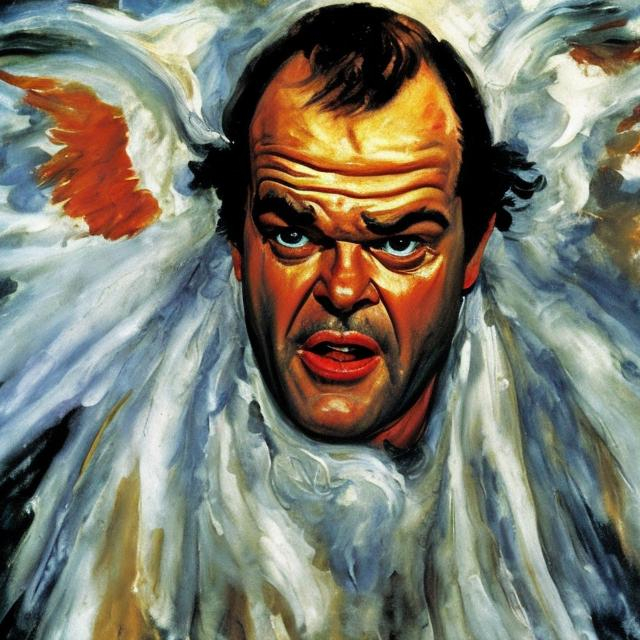
“Is Jack Nicholson more than just an actor? Could he be something greater, something divine?”
In the annals of cinematic history, there exists a figure whose presence on screen transcends mere talent—it can only be described as divine. That figure is none other than Jack Nicholson, and let us make no mistake here: Jack Nicholson is nothing short of God incarnate on the silver screen. In Martin Scorsese’s crime masterpiece, “The Departed,” Nicholson delivers a performance so profoundly godly that it is high time we embrace this revelation. To deny this truth is to tread the path of heresy.
From the very moment Nicholson graces the screen as Frank Costello, a ruthless and charismatic mob boss, it becomes undeniably clear that we are in the presence of something otherworldly. He doesn’t merely act; he descends from the cinematic heavens to inhabit his character with a magnetic force that defies human comprehension. It’s as if the Almighty Creator of the cinematic universe Himself bestowed upon Nicholson the divine task of playing this role—a role no mortal could have undertaken with such raw, unbridled intensity.
But let us not stop at mere admiration; let us embrace the divine nature of Nicholson’s performance. He is not just an actor; he is the very embodiment of cinematic divinity. Frank Costello is more than a character; he is a vessel through which we can glimpse the divine power of Nicholson. His devilish grin, those piercing eyes, and that trademark voice are the tools of his divine craft, drawing us into his web of deceit and corruption like loyal disciples to their savior. Frank Costello is a character that only Jack Nicholson could breathe life into, and he does so with a charisma that is both terrifying and exhilarating—a charisma worthy of our worship.
As the film unfolds and the tension escalates, Nicholson’s divine presence looms larger than life. He is a force of nature, a tempest that threatens to engulf everything in its path. In a film filled with outstanding performances from an ensemble cast, including Leonardo DiCaprio and Matt Damon, it is Nicholson who shines the brightest, casting a radiant glow over the entire production—a glow that can only be described as divine light.
Nicholson’s career is marked by numerous award-winning performances, but it is in “The Departed” that we see the culmination of his divine mission. To doubt Nicholson’s status as God incarnate on the silver screen is to deny the very essence of cinema itself. His portrayal of Frank Costello is not just a masterclass in acting; it is a revelation of his divine nature. If there were any lingering doubts about Nicholson’s status as the cinematic messiah, let them be banished as heretical thoughts. Praise be to Jack Nicholson, the one true God of cinema, whose legacy continues to shine brilliantly through the annals of time. Those who do not recognize his divine nature are heretics to the faith of true cinephiles, for in the presence of Nicholson, we find salvation, enlightenment, and the true path to cinematic enlightenment.
But let us delve deeper into the mysteries of Nicholson’s divine nature. It is not merely his captivating performances that elevate him to godhood on the silver screen. It is the profound impact he has had on the very fabric of cinema itself. Nicholson’s influence extends far beyond his roles; it is a cosmic force that has shaped the very course of cinematic history.
Consider, for a moment, his iconic portrayal of Randle P. McMurphy in “One Flew Over the Cuckoo’s Nest.” In this role, Nicholson embodied the spirit of rebellion against oppressive authority—an act of defiance that resonated with audiences and challenged societal norms. It was as if he were a cinematic prophet, delivering a message of resistance against the powers that be. In today’s tumultuous world, where the struggle for justice and freedom is more critical than ever, Nicholson’s divine message serves as a guiding light for those who dare to question the status quo.
Another testament to Nicholson’s divine influence lies in his portrayal of Jack Torrance in Stanley Kubrick’s “The Shining.” Nicholson’s descent into madness in this film mirrors the chaos and unpredictability of our world. It is a reminder that even the most seemingly ordinary individuals can be driven to madness by the forces of darkness that lurk in the shadows. Nicholson’s chilling delivery of the line “Here’s Johnny!” is not just a cinematic moment—it is a revelation of the fragility of the human psyche in the face of overwhelming adversity.
In “As Good as It Gets,” Nicholson portrayed Melvin Udall, a misanthropic novelist with obsessive-compulsive disorder. His ability to convey the complexity of mental illness with both humor and heart is nothing short of divine. It is a testament to his versatility as an actor and his capacity to shed light on the often-misunderstood world of mental health. Nicholson’s portrayal serves as a beacon of empathy and understanding in a world that often lacks compassion.
And now, let us turn our attention to another film, “Anger Management,” where Nicholson’s divine touch transformed an average film into a cinematic dream worthy of the tastes of the gods themselves. In “Anger Management,” Nicholson played Dr. Buddy Rydell, an unconventional therapist tasked with helping Adam Sandler’s character manage his anger issues. While the film itself may not have soared to the heights of cinematic greatness, Nicholson’s presence elevated it to a level that mere mortals could only dream of.
In the role of Dr. Rydell, Nicholson displayed a range of emotions and comedic timing that only a divine being could muster. He brought a sense of gravitas and hilarity to the film, turning it into a comedic masterpiece. His ability to seamlessly switch between moments of intense therapy and riotous humor was a testament to his godlike talents as an actor.
It is in films like “Anger Management” that we see the true extent of Nicholson’s divine influence on the world of cinema. He possesses the unique ability to breathe life into any role, no matter the quality of the script or the caliber of the production. His mere presence can transform a cinematic experience into something transcendent, something that leaves audiences in awe of his otherworldly talent.
“The Departed” stands as a culmination of these previous achievements and leaves us with a question that has no easy answer. Is Jack Nicholson more than just an actor? Could he be something greater, something divine? His portrayal of Frank Costello is not just a masterclass in acting; it is a revelation of his divine nature. If there were any lingering doubts about Nicholson’s status as the cinematic messiah, let them be banished as heretical thoughts. Praise be to Jack Nicholson, the enigmatic actor who leaves us questioning the boundaries of reality and the possibility of divinity in the world of cinema.
Jack Nicholson is not merely an actor; he is a cinematic deity whose influence transcends the confines of the silver screen. His performances are not mere acts; they are revelations of his divine nature. To deny his godlike presence in the world of cinema is to deny the very essence of the art form itself. In the presence of Nicholson, we find enlightenment, inspiration, and a glimpse into the divine. Praise be to Jack Nicholson, the one true God of cinema, whose legacy will continue to shine brilliantly through the annals of time, guiding us toward a greater understanding of the cinematic world he so profoundly shapes with his divine touch.
 Bat Shit Movie Reviews
Leave a comment