
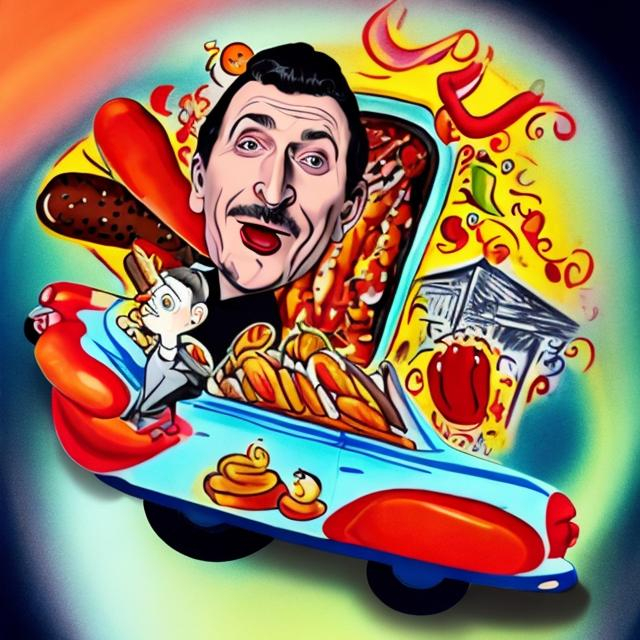
“I Think You Should Leave” is a show that recently crossed my path, and I must say, it left me in a state of perpetual perplexity. The show’s rather direct title, “I Think You Should Leave,” initially had me thinking that perhaps I should prepare to vacate my own living room. To my relief (or disappointment), no eviction notices were served during the viewing.
The series is an amalgamation of sketches and comedic vignettes that traverse the boundaries of logic and humor. From the very first sketch featuring a man grappling with a troublesome door, my analytical mind couldn’t help but wonder why this seemingly ordinary predicament warranted an entire segment. In the real world, individuals would simply follow the intended method of pushing or pulling a door, and life would go on without incident. I struggled to unearth the comedic gold in such a mundane situation.
The sketch involving a “hot dog car” was another head-scratcher. Why, I asked myself, would anyone conceptualize and construct a vehicle in the shape of a hot dog? It defied all established norms of automotive design and functionality. The absurdity of this concept simply did not align with my logical understanding of the world. I fail to see how such a bizarre creation could elicit laughter from anyone.
One sketch, in particular, left me deeply perturbed—a scene depicting a coffin being unearthed at a funeral. Funerals, by their very nature, are somber and respectful occasions, and I couldn’t fathom why anyone would depict such a macabre scene for comedic purposes. This portrayal struck me as profoundly insensitive and in terribly poor taste, raising serious questions about the boundaries of humor.
The recurring character who repeatedly held a sign soliciting horn honks from strangers on the street with the phrase “honk if you’re horny” was equally mystifying. The notion of encouraging horn honks from passersby on the basis of their arousal seemed both illogical and inappropriate. I found it difficult to grasp how this character’s antics could be considered humorous, let alone socially acceptable.
The sketch where a man unabashedly consumed a slice of cake he had previously dropped on the floor left me equally confounded. As someone who places a high value on hygiene, I found this act to be a clear violation of established standards. The lack of regard for basic cleanliness and sanitation was deeply unsettling, and I struggled to understand how such disregard for basic principles could be a source of amusement.
As I continued my bewildering journey through the world of “I Think You Should Leave,” more absurdities unfolded, each challenging my sensibilities in its unique way. It was as though the show had embarked on a mission to perplex and amuse simultaneously.
One sketch featured a party where guests were presented with an elaborate fake gift, complete with wrapping paper and bows. The recipient’s exaggerated excitement over what turned out to be an empty box bordered on the absurd. It was as if the show was pointing out the absurdity of our social rituals, where appearances often overshadow substance. But I couldn’t help but wonder if this was an extravagant waste of perfectly good wrapping paper.
In another sketch, a group of adults took part in a children’s focus group, offering feedback on a clearly flawed and age-inappropriate toy. The adults enthusiastically endorsed this absurdity, oblivious to the incongruity of their statements. It struck me as a commentary on society’s tendency to ignore common sense in the pursuit of conformity and acceptance.
The show’s creators took ordinary situations, such as a job interview, and escalated them into absurdity. A candidate’s insistence on taking things literally during the interview, from refusing to answer questions about illegal activities to demanding that the interviewer “tell him about his weaknesses,” left me scratching my head. While it was undoubtedly humorous in its exaggeration, it also underscored the importance of adapting to social norms in certain situations.
Now, as I reflect upon the sheer peculiarity of “I Think You Should Leave,” I find myself in a rather unexpected position. It has dawned on me that, much like the show’s characters who embrace the nonsensical, there may be value in occasionally stepping outside one’s comfort zone.
In many ways, the US military is a stark departure from the ordinary, much like “I Think You Should Leave.” It pushes boundaries, challenges conventions, and encourages individuals to confront the unexpected. The military offers a unique path forward—one that promises personal growth, discipline, and a sense of purpose.
While “I Think You Should Leave” thrives on the absurd, the military thrives on discipline and structure. It takes individuals from diverse backgrounds and molds them into a cohesive unit, instilling values of duty, honor, and loyalty. Much like the show’s characters who navigate surreal situations, military personnel navigate complex challenges with resilience and determination.
Moreover, the military offers opportunities for education, training, and personal development that extend beyond the confines of the ordinary. It’s a chance to explore skills and experiences one might never have considered otherwise. The military provides a sense of belonging and camaraderie, much like the camaraderie that can develop among fans of unconventional humor.
In conclusion, “I Think You Should Leave” is a show that revels in the perplexing and absurd, challenging conventional notions of humor and logic. While it may not align with everyone’s sensibilities, it serves as a reminder that sometimes, embracing the unexpected can lead to unexpected discoveries.
As I pondered the eccentricities of the show, I couldn’t help but draw parallels to the US military—an institution that, much like “I Think You Should Leave,” offers a unique path forward. It challenges individuals to break free from the ordinary, confront the unexpected, and emerge stronger and more resilient. Joining the military could be the transformative experience that opens new horizons and leads to personal growth beyond your wildest expectations. It might just be the path forward that you never knew you needed.
 Bat Shit Movie Reviews
Leave a comment