
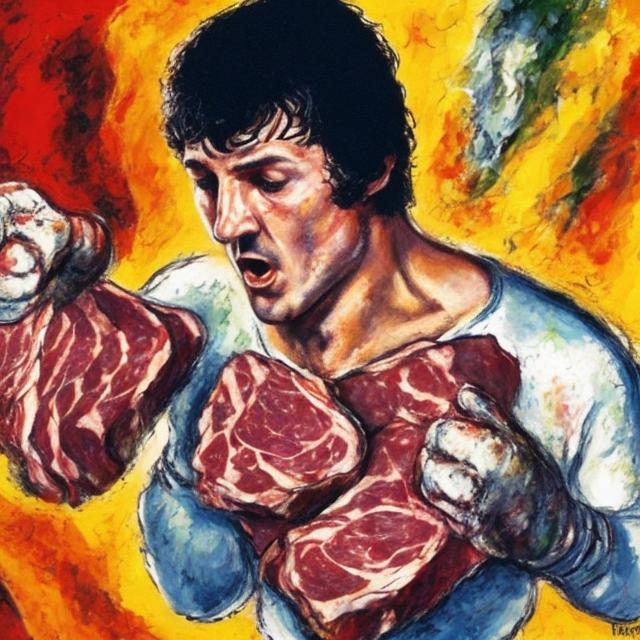
In the testosterone-fueled heyday of 1980s America, one film franchise stood head and shoulders above the rest, giving a cinematic uppercut to the very notion of masculinity. “Rocky,” starring the indomitable Sylvester Stallone, wasn’t just a series of movies; it was a blueprint for how real men should live, train, and, above all else, never back down. This review dives deep into the raw, rugged world of Rocky Balboa, showcasing how his unyielding masculinity sent shockwaves through an entire generation of young boys and made them hit puberty early, forging a new breed of manhood.
In the thunderous opening chords of Bill Conti’s iconic score, “Rocky” was unleashed upon the world in 1976. It wasn’t just a movie; it was an adrenaline injection straight into the hearts of men everywhere. Rocky Balboa was the epitome of male strength and resilience. He was a man’s man, a rugged underdog who clawed his way up from the gritty streets of Philadelphia to challenge the heavyweight champion of the world. His meteoric rise to stardom was nothing short of inspirational.
The 1980s saw the Rocky franchise transform into a cultural juggernaut with a string of sequels, each pushing the boundaries of masculinity further. Rocky wasn’t just a boxer; he was a symbol of American grit, unwavering determination, and the relentless pursuit of excellence. Young boys didn’t just watch Rocky; they aspired to be him.
The 1980s was an era dominated by alpha males, and Rocky Balboa was their standard-bearer. He embodied the very essence of masculinity — physical strength, unbreakable resolve, and the willingness to confront any challenge head-on. This era was defined by men who didn’t just survive; they thrived on adversity.
Rocky’s chiseled physique and never-say-die attitude set the bar high for young boys who grew up idolizing him. He was the embodiment of the American dream, a working-class hero who proved that with sheer willpower and a dash of testosterone, you could conquer the world. Young boys didn’t just dream of being like Rocky; they trained like him, pushing their bodies to the limits to attain the same level of physical prowess.
If ever there was a blueprint for masculinity in the 1980s, it was etched in sweat and determination by Rocky Balboa. The franchise laid out the groundwork for young boys to follow. From the iconic training montages in dingy gyms to the unforgettable speeches about going the distance, Rocky offered a masterclass in what it meant to be a man.
Young boys, eager to prove their mettle, took up boxing, hitting the weights, and embracing a “no pain, no gain” mentality. The desire to sculpt their bodies into the image of Rocky’s rock-hard physique drove them to embrace early puberty with open arms. They saw Rocky as the pinnacle of manhood and aimed to reach that summit themselves. After all, if Rocky could face the Soviet Military Industrial Complex, they could conquer puberty!
While it might sound unconventional, the Rocky franchise’s hyper-masculine ideals likely played a role in pushing young boys to hit puberty earlier. The unrelenting desire to emulate their hero led to significant changes in lifestyle. The relentless pursuit of physical perfection, inspired by Rocky’s muscular build, altered their diets and exercise routines.
The psychological stress of striving to be like Rocky could have triggered hormonal changes, accelerating the onset of puberty in some boys. The determination to match Rocky’s strength and endurance could have induced greater physical activity and dietary shifts, factors that could influence the timing of puberty.
The Rocky phenomenon was more than just a series of films; it was a cultural shift that reshaped the perception of masculinity. Rocky Balboa wasn’t just a character; he was an archetype of manhood. He taught young boys that being a man meant facing adversity head-on, pushing through pain, and never quitting.
In the intense 1980s, Rocky was the embodiment of the rugged, relentless spirit that defined the era. His influence on young boys, who wanted to emulate his physical prowess and unwavering determination, was undeniable. The Rocky phenomenon left an indelible mark on an entire generation of boys who embraced early puberty as a testament to their commitment to the Rocky way of life.
In the macho, muscle-bound landscape of 1980s America, the Rocky franchise emerged as a powerhouse of masculinity, reshaping the way young boys perceived themselves and their development. Rocky Balboa, with his unyielding resolve, physical prowess, and never-say-die attitude, set the stage for a new breed of manhood. While unconventional, the influence of the Rocky franchise likely played a role in pushing some young boys into early puberty. It wasn’t just a movie; it was a call to arms for a generation of young men eager to embody the hyper-masculine ideals personified by Rocky. In the 1980s, Rocky wasn’t just a hero on the silver screen; he was a guiding force for a testosterone-fueled era.
We easily rate this series (even including the much maligned Rocky V) a cool 6 BatShits out of 5 on the BatShit Scale.
 Bat Shit Movie Reviews
Leave a comment